
AI Governance | Responsible AI | EU AI Act
AI Governance & EU AI Act Compliance
Adopt AI with confidence. Zaviant helps you build a responsible AI Governance program, assess and reduce AI risk, and meet obligations under the EU AI Act, the NIST AI Risk Management Framework, and ISO/IEC 42001.
Definition
What is AI Governance?
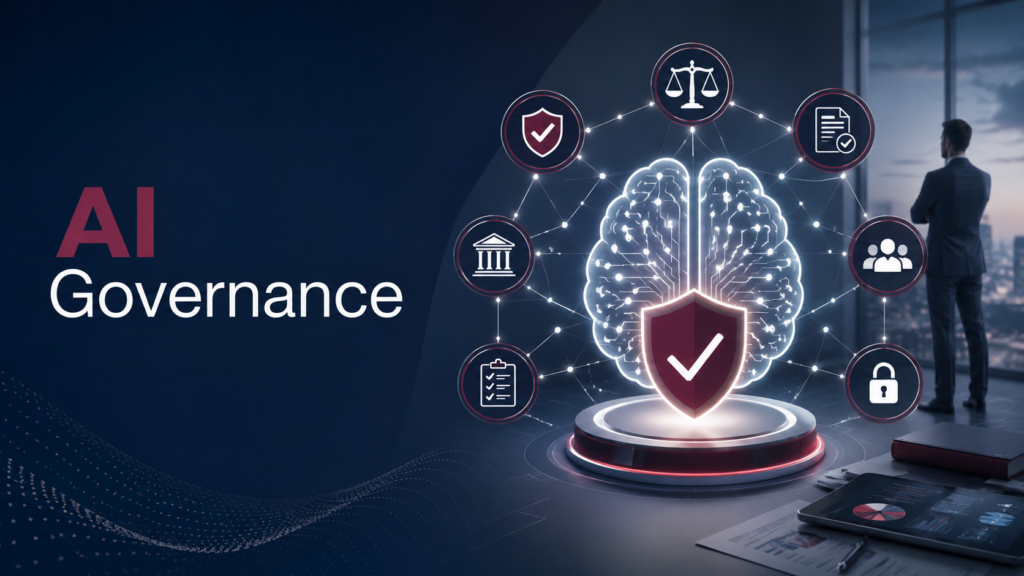
AI governance is the set of policies, processes, roles, and controls an organization uses to develop, deploy, and monitor artificial intelligence responsibly. It exists to capture the value of AI while managing its risks, bias, discrimination, privacy harms, security exposure, and a lack of transparency or accountability.
A mature AI governance program does four things well: it gives leaders visibility into where AI is used, it assesses the risk of each use case, it sets guardrails for how AI is built and bought, and it monitors systems over time as models, data, and regulations change. Done right, governance is not a brake on innovation, it is what lets an organization scale AI safely and defensibly.
Governance also connects AI to the rules that already govern data. Because most AI systems are trained on and process personal data, AI governance overlaps heavily with privacy law (such as the GDPR and US state privacy laws) and with information security. Treating these as one connected program, rather than separate silos, is what distinguishes effective governance from a paper policy.
The Stakes
Why AI Governance matters now
Three forces are converging. First, adoption is outpacing oversight, employees are using generative AI tools faster than most organizations can inventory them, creating “shadow AI” that touches sensitive data without review. Second, regulation has arrived: the EU AI Act is in force, US states such as Colorado have passed AI legislation, and sector regulators are issuing AI guidance. Third, trust is now a differentiator, customers, partners, and boards increasingly expect evidence that AI is used fairly and securely.
What a strong program protects you from
Reduced risk exposure. Structured assessment and controls reduce the chance of biased outcomes, privacy violations, and security incidents tied to AI systems and their training data.
A stronger brand and reputation. Demonstrable transparency and accountability in how AI makes or supports decisions builds durable trust with stakeholders and regulators.
Faster, safer innovation. Clear guardrails let teams experiment and deploy AI with confidence, rather than freezing for fear of getting it wrong.
Regulatory Deep Dive
The EU AI Act, Explained
The EU AI Act (Regulation 2024/1689) is the world’s first comprehensive law governing artificial intelligence. It entered into force on 1st August 2024 and applies in staggered phases. Its central idea is a risk-based approach: the higher the risk an AI system poses to health, safety, or fundamental rights, the stricter the obligations.
Critically, the Act has extraterritorial reach. If you provide an AI system on the EU market, or the output of your AI system is used in the EU, the Act can apply to you regardless of where your organization is based. For US and global companies, “we’re not an EU company” is not a safe assumption.

The Four Risk Tiers
Click on each button below to see what it means and for an example:
What it means:
Banned outright
Examples:
Social scoring by public authorities, manipulative or exploitative systems, most untargeted facial-recognition scraping
What it means:
Strict obligations: risk management, data governance, documentation, human oversight, accuracy & security
Examples:
AI in hiring and HR, credit scoring, education, essential services, law enforcement, and safety components of regulated products
What it means:
Transparency obligations
Examples:
Chatbots and AI-generated content (deepfakes) must be clearly disclosed to users
What it means:
No mandatory obligations
Examples:
AI spam filters, recommendation features, AI in video games
Compliance Timeline
The Act’s obligations phase in over several years. The dates below reflect the statutory timeline, alongside the deferrals proposed in the 2026 “Digital Omnibus” simplification package.
-
EU AI Act enters into force In effect
1st Aug 2024
-
Bans on unacceptable-risk AI + AI literacy obligations apply In effect
2nd Feb 2025
-
General-purpose AI (GPAI) model rules + EU governance bodies In effect
2nd Aug 2025
-
Most remaining rules; high-risk (Annex III) obligations; Article 50 transparency; enforcement begins Active - Annex III high-risk proposed to defer to Dec 2027
2nd Aug 2026
-
High-risk AI embedded in regulated products (Annex I) Proposed to defer to Aug 2028
2nd Aug 2027
On 7th May 2026, EU negotiators reached a provisional agreement on the Digital Omnibus on AI, which would postpone use-based (Annex III) high-risk obligations from 2nd August 2026 to 2nd December 2027, and product-embedded (Annex I) obligations from 2nd August 2027 to 2nd August 2028. These changes take legal effect only once formally adopted and published in the Official Journal, so until then, the original 2nd August 2026 date remains active and organizations should keep preparing against it.
Penalties for non-compliance
Violation
Maximum Fine
Prohibited AI practices
€35 million or 7% of total worldwide annual turnover, whichever is higher
Most other obligations (including high-risk requirements) higher
€15 million or 3% of worldwide annual turnover
Supplying incorrect or misleading information to authorities
€7.5 million or 1% of worldwide annual turnover
How this connects to your governance program
The Act does not ask for a one-time certificate, it asks for an operating system. High-risk obligations such as risk management, data governance, technical documentation, logging, human oversight, and post-market monitoring are exactly the capabilities a real AI governance program provides. Building governance now means EU AI Act readiness becomes a by-product, not a fire drill.
Explore Zaviant’s dedicated EU AI Act compliance services.

The Key AI Governance Frameworks
Most organizations don’t rely on a single rulebook. They combine a binding law (the EU AI Act) with operational frameworks that make compliance demonstrable and repeatable. The three below are the foundation of modern AI governance.
EU AI ACT
Binding EU law. Risk-based obligations with significant penalties and extraterritorial reach.
NIST AI RMF
Voluntary US framework structured around four functions: Govern, Map, Measure and Manage AI risk.
ISO/IEC 42001
The first certifiable AI management system standard, an auditable backbone for governance at scale.
Used together, NIST AI RMF and ISO/IEC 42001 give you the controls and evidence that satisfy regulators, while the EU AI Act and emerging US state laws (such as Colorado’s AI Act) define what you are accountable for.
Our Services
How Zaviant Helps
We meet you wherever you are, whether you need a first AI inventory, a defensible governance program, or EU AI Act readiness on a deadline. Our consultants combine deep privacy, security, and regulatory expertise so AI Governance is built on solid ground.
AI governance program development
Policies, roles, and an AI governance committee tailored to how your organization actually builds and buys AI.
AI risk assessments
Use-case-level assessment of bias, privacy, security, and regulatory risk, with prioritized remediation.
EU AI Act readiness
Classify your systems by risk tier, map obligations, and close gaps before enforcement applies.
AI inventory & discovery
Find shadow AI and build a living register of every model and AI vendor touching your data.
Monitoring & compliance reporting
Ongoing reporting on model performance, risk, and adherence to data-protection laws.
Virtual CISO & advisory
Senior, on-demand leadership to keep your AI governance program current as rules evolve.
Engagement
Our AI Governance Process
Discover
Inventory where AI is used across your organization, including third-party and embedded AI.
Assess
Evaluate each use case for risk and map it to applicable laws and frameworks.
Design
Build the policies, controls, and governance structure proportionate to your risk.
Implement
Operationalize controls, train teams, and embed governance into procurement and development.
Monitor
Continuously review systems and regulations, reporting to leadership and adapting as needed.
Questions
AI Governance & EU AI Act FAQ
What is AI governance?
AI governance is the set of policies, processes, roles, and controls an organization uses to develop, deploy, and monitor AI responsibly. It manages risks such as bias, privacy violations, and lack of transparency, and aligns AI use with regulations like the EU AI Act and frameworks such as the NIST AI RMF and ISO/IEC 42001.
Does the EU AI Act apply to companies outside the EU?
Yes. The EU AI Act applies extraterritorially. If your AI system is placed on the EU market, or its output is used within the EU, the Act can apply regardless of where your company is headquartered.
When do EU AI Act high-risk obligations take effect?
Under the original timeline, obligations for high-risk AI systems listed in Annex III apply from 2nd August 2026, and for AI embedded in regulated products (Annex I) from 2nd August 2027. A provisional Digital Omnibus agreement reached on 7th May 2026 would defer these to 2nd December 2027 and 2nd August 2028 respectively, but it only takes effect once formally adopted and published, so the original dates remain active until then.
What are the penalties under the EU AI Act?
Fines reach up to €35 million or 7% of total worldwide annual turnover for prohibited AI practices, up to €15 million or 3% for most other violations, and up to €7.5 million or 1% for supplying incorrect information to authorities, whichever amount is higher in each case.
How is the EU AI Act different from the NIST AI RMF?
The EU AI Act is a binding law with legal penalties. The NIST AI Risk Management Framework is a voluntary US framework that helps organizations govern, map, measure, and manage AI risk. Many organizations use NIST AI RMF and ISO/IEC 42001 as the operational backbone that demonstrates EU AI Act compliance.
What is "shadow AI" and why does it matter?
Shadow AI refers to AI tools used by employees without organizational review or approval. It matters because these tools can process sensitive or personal data outside any governance, privacy, or security controls, creating risk that leadership cannot see. An AI inventory is usually the first step to bringing it under control.
Trusted by Leaders of Industry
Our team of expert consultants works closely with Fortune 500 companies, mid-market businesses, and not-for-profit organizations spanning industries including retail, manufacturing, finance, technology, and more.






Build AI Governance you can defend.
Talk to Zaviant about an AI inventory, a Risk Assessment, or EU AI Act readiness.
We’ll help you adopt AI responsibly.

Last updated June 2026 · Reviewed by Zaviant’s AI Governance, Privacy & Security advisory team · This page is for general information and is not legal advice.